


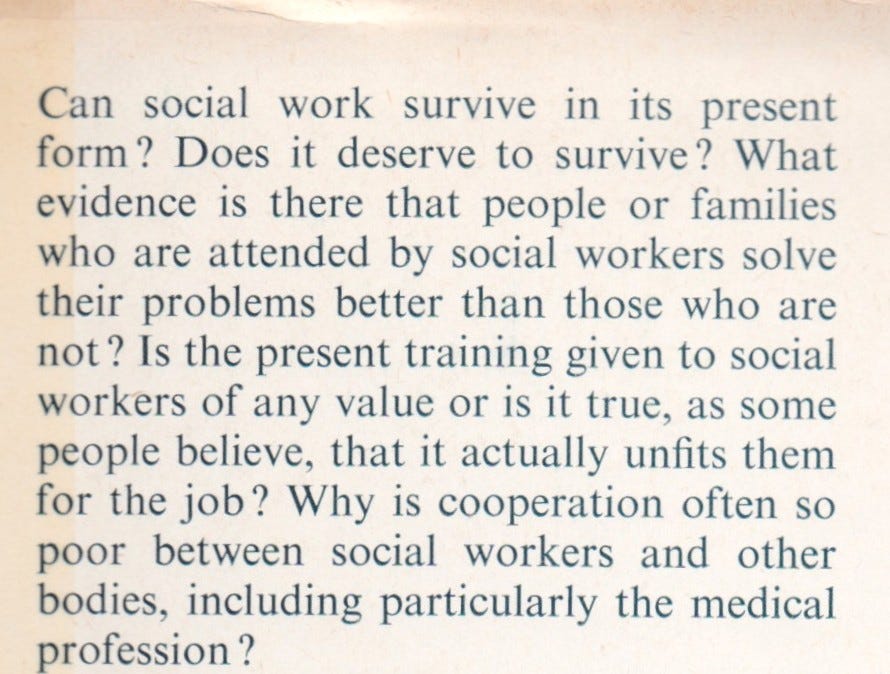
This post looks at the remainder of Brewer and Lait’s (1980) attack on social work, having glanced last week at their comments on social work’s history and social work education in the late 1970s. You can see in the picture at the head of this post what the publisher’s blurb says about their aims.
The remainder of the book contains nine more chapters, in groups:
(Chapters 3-4, pp. 47-92) on social work in the new local government social services departments (SSDs – social work departments in Scotland, but they do not make the distinction) after 7-8 years of operation (but also including a reorganisation of the health services that incorporated healthcare social work into the departments) and on social work and mentally ill people, presumably a special interest of psychiatrist Brewer.
(Chapters 5-7, pp. 93-125) rather less substantial comments on developments in social work (as opposed to the SSDs), picking up whether social work is becoming too bureaucratic, too psychotherapy oriented or ignoring residential practice; on the radical trend of the 1970s and some developments in private practice.
(Chapters 8-10, pp 126-190) what really seems to interest them, on whether social work (particularly psychodynamic social work) is effective.
(Chapter 11, pp. 191-210) their proposals.
On the Seebohm Report and the SSDs
They are dismissive of the Seebohm Report, whose proposals aimed to unify local government social work and related services.
The present authors do not believe that any [unifying factors] exist, and think that the unified social services departments constructed on a false unity owe much of their ineffectiveness to the absence of such analysis [a more intellectually rigorous approach to identifying unifying factors] (p. 48).
One possible factor was that the Report wanted to reject the idea of serving only a stigmatised group of ‘disadvantaged’ people. Another was that many members of the committee had been appointed to recommend their already decided preferences.
While the Committee was doubtful about defining a service as one for families:
‘…[t]hey nevertheless continue to use the term ‘family service’ as if it were capable of some practical application, and was not simply (in this context) a phrase designed to evoke warm sentiments. (Family toilet rolls recently caught our eye. The advertisers are unashamedly in the business of selling. Seebohm wasn’t, or shouldn’t have been.)(p. 49)
A random and irrelevant condescending observation. And just purposely naïve about the role of government committees proposing reforms.
Other points they make:
Resources were claimed to be inadequate, but no objectives are defined to allow an assessment of appropriate resources.
Evidence was collected in a random way (pp. 50-3), and the 5-year period of the Committee’s work should have been used to evaluate demand and set precise objectives; it over-relied on evidence of ‘prevailing opinions’ (quoted from the Report).
It over-stresses preventive work, looking beyond immediate symptoms (this concern partly derives from a criticism of psychoanalytic ideas that practical ‘presenting problems’ conceal more complex psychological disturbance), and wants, with little justification, new and better staff and more resources (pp. 53-5).
Moving on to SSDs
Brewer and Lait, focusing on ‘fieldwork activities’ that use social work methods rather than the broader aims of SSDs, hoped for better evidence of demand once the SSDs were in operation. But, quick to denigrate social workers if they can, the fact that little material is available ‘…is further evidence of the inability or unwillingness of field social workers to evaluate their activities…(p. 55), despite large government funded studies, which provide lots of information and, to some extent, they fillet for critical comments. Brewer and Lait find that resources have increased, but note that preventive work is designed to prevent institutionalisation. But there are still large numbers of children and older people in care homes.
Their proposal is specific, measurable, short-term objectives.
We do not blame trained social workers for their frustration at not attaining the objectives for which their training had, in its muddled fashion, prepared them. We also wonder whether selection of social workers, either for training or employment, can be done with much skill…when we find that although 99% of a sample of newly trained social workers…had been compelled to deal with financial problems, only 33% liked doing so (p. 59).
The British social security system is specifically designed to be separate from social welfare provision, and has been since the Poor Law (in which the two were intertwined) died its death. Passing slurs, for example ‘muddled’. Their criticism here is against casework focused on psychological problems rather than immediate practicalities, but presented as disparagement of social work attitudes and competence.
Later, looking at some of the research:
…the reference of the accessibility of advice is one of several clues suggesting that the northern borough, with its compact area and low proportion of rained staff from outside, had fewer miserable social workers than any of the other areas. Neither, unfortunately but not unexpectedly was it the purpose of the enquiry to ascertain which area had the least miserable clients…(p. 64).
The chapter moves on to argue that health visitors with a healthcare approach and better relationships with general practitioners (family doctors) would be more valid than the sort of work that the DSDs and social workers were doing.
The following chapter in social work and mentally ill people is briefer. It starts from:
In spite of the large amount of evidence that most social work activity does not benefits its clients and may actually harm them, relatively few critics of social work have concentrated on the issue of effectiveness, at least until recently and particularly following the strike of social workers in Britain in 1978-79 (p. 86).
A paragraph irrelevant to the topic of the Chapter, just to remind readers of the authors’ opinions about social work. It goes on to look at a study of an SSD in a rural area and finds that little of it was concerned with mentally ill people, and a lot of it was ‘wasted’ on bureaucratic activity, such as desk work and meetings. As with general health, community psychiatric nurses would be a better investment, partly because they had close geographic and professional links with psychiatrists (like Brewer?) who were likely to have the lead role in working with mental illness.
The following chapter moves on to complain about the confusion of bureaucratic and therapeutic work in local government social services, on the influence of psychoanalytic ideas tat have created a similar form of practice in casework. Moreover, there are anti-scientific attitudes in casework.
A final point in the chapter is a brief discussion of residential provision, noting that most clients with complex difficulties were placed in institutions with the least qualified workers.
If social work training is supported to provide a greater ability to help more disturbed, deprived, or deviant members of society, it may be thought curious that residential social workers, who often have eat closest and most prolonged contact with these groups, generally have much less training that the fields social workers, who, in many cases, will have requested residential cases when their own psychotherapeutic efforts have bene unsuccessful (p. 103).
The following chapter discusses some of he literature that came out in the 1970s on radical social work:
A mixed bag indeed, the unifying theme of which appears to be the sabotaging of any system which gives help to deprived groups unless the helpers accept unquestioningly that ‘the system’, i.e. capitalism, causes the problem and must be overthrown before we can be rid of wide battering and mental illness (p. 113).
And private practice, little available in the UK compared with the USA, is criticised for being concerned mainly with psychotherapeutic activity, that fails to prioritise excluding medical conditions prior to providing treatment (p. 124).
It might be considered churlish to ask whether private practitioners get more pleasure and satisfaction from doing psychotherapy with fellow members of the middle classes with whom they can readily communicate and identity, than acting as reluctant and itinerant bureaucrats, social policemen, and purveyors of assorted material handouts to unappreciated members of the proletariat…We rather suspect they do (pp. 124-5).
Another series of undiscussed insults about public social welfare provision.
Empirical research evidence on effectiveness
The following chapters focus on the difficulty of effectiveness research, except by using single case experimental designs and more extensive studies using control groups. It reviews the effectiveness research on social work, using such research methods, citing Fischer (1976) and some of the American studies included in his analysis. We have been looking at these concurrently in my series of posts on Social work history in 20 books, bearing in mind Fischer’s influence on attitudes to social work generally in the 1970s. Brewer and Lait also comment on some British studies which Fischer excluded from his solely American text, some of which had been published after Fischer’s book came out. The argument is the same as Fischer’s, that there is little evidence of the effectiveness of social casework, perhaps particularly when based on psychanalytic ideas, in achieving intended outcomes, if these could be defined, which they often weren’t.
Brewer and Lait go rather beyond Fischer’s work, since they extend his findings to claim the ineffectiveness of all social work, not just psychodynamic casework, although that remains their main target. Although individual casework was still a strong element of the social work Brewer and Lait were exploring, there were the beginnings of a wider basis for practice. And social work as used in SSDs was part of a much broader public service with wider government public service aims; social work was only a small part of the expenditure and workforce. But Brewer and Lait were right to say that the traditional casework training of the 1960s for people incorporated into social work education did not serve these broader purposes.
What to do?
Brewer and Lait’s proposals at the end are partly hung on suggestions from the British Association of Social Workers and others that a broad inquiry was needed into SSDs, and this did indeed come to pass in the Barclay Report (1982). That’s another story.
But you will have guessed from my brief account of some of their material the nature of Brewer and Lait’s proposals. They argue for:
a much more tightly defined definition of the aims and practices of SSDs and social work within them; they really just don’t like public-funded, local government managed social services, and don’t see the point of social work at all;
practice methods justified by research using empirical methods, emphasising behaviour objectives in practice;
consumer studies, rigorously conducted, so that services better met the preferences of clients, rather than the ‘confused’ ideals of practitioners;
evidence about relationships and cooperation with healthcare and social security services and their workers;
changes to social work education which should be focused on ‘secondment and apprenticeship’ schemes (p. 203) and teaching methods that have been rigorously researched.
It appears unlikely that many of the people presently engaged in training social workers would willingly participate in secondment and apprenticeship schemes, or be capable of undertaking training in methods which have been shown to have some prospects of success. We think…that many, if not all existing training courses should be shut down. We think that social work trainers and social workers who, in spite of evidence to the contrary, believe their methods are effective, should consider private practice…But the expensive ‘casework services’ have not generally been shown to be acceptable, popular or useful, and we see little reason for retaining them under public funding; absolutely none for expanding them. It may be that casework-trained social workers have skills which are marketable to middle-class neurotics…but we believe the only real test of this hypothesis must be a market test (p. 203).
Another of the many comments on social work education, belittling it as pointless.
What to think?
Many of the points that Brewer and Lait make about casework of the 1970s and the attempt to create comprehensive social agencies based on the practice methods in use at the time are not unreasonable. But the continuous contemptuous denigration suggested an animus against something: critical analysis in a controversialist series of books does not have to be gratuitously offensive.
Could a specific form of social work, casework, a minor aspect of the new comprehensive British public provision, be the easy target for the much more important policy objective of public authorities taking on shared responsibility for others? Or for the trying to intervene in social? And could it reflect a conservative opposition to public welfare provision of anything but the most practical and prosaic? (Unless it’s medical?)
Brewer, C. & Lait, J. (1980) Can social work survive? London; Temple Smith.
Fischer, J. F. (1976). The effectiveness of social casework. Springfield, IL: Thomas.