

Methods for managing the poor in the past...
...and links with official practices now

A stigmatising notice
Another ‘local history teaching file’ (Caernarvonshire Record Office, n. d.) that I picked up at some museum illustrates provision for people in poverty in Wales over the centuries from the 1600s to the 1800s. It was (cheaply photocopied in a stupendously undesigned paper cover - no efforts at modern marketing here) produced by archives service of Caernarvonshire County Council as a local school teaching resource.
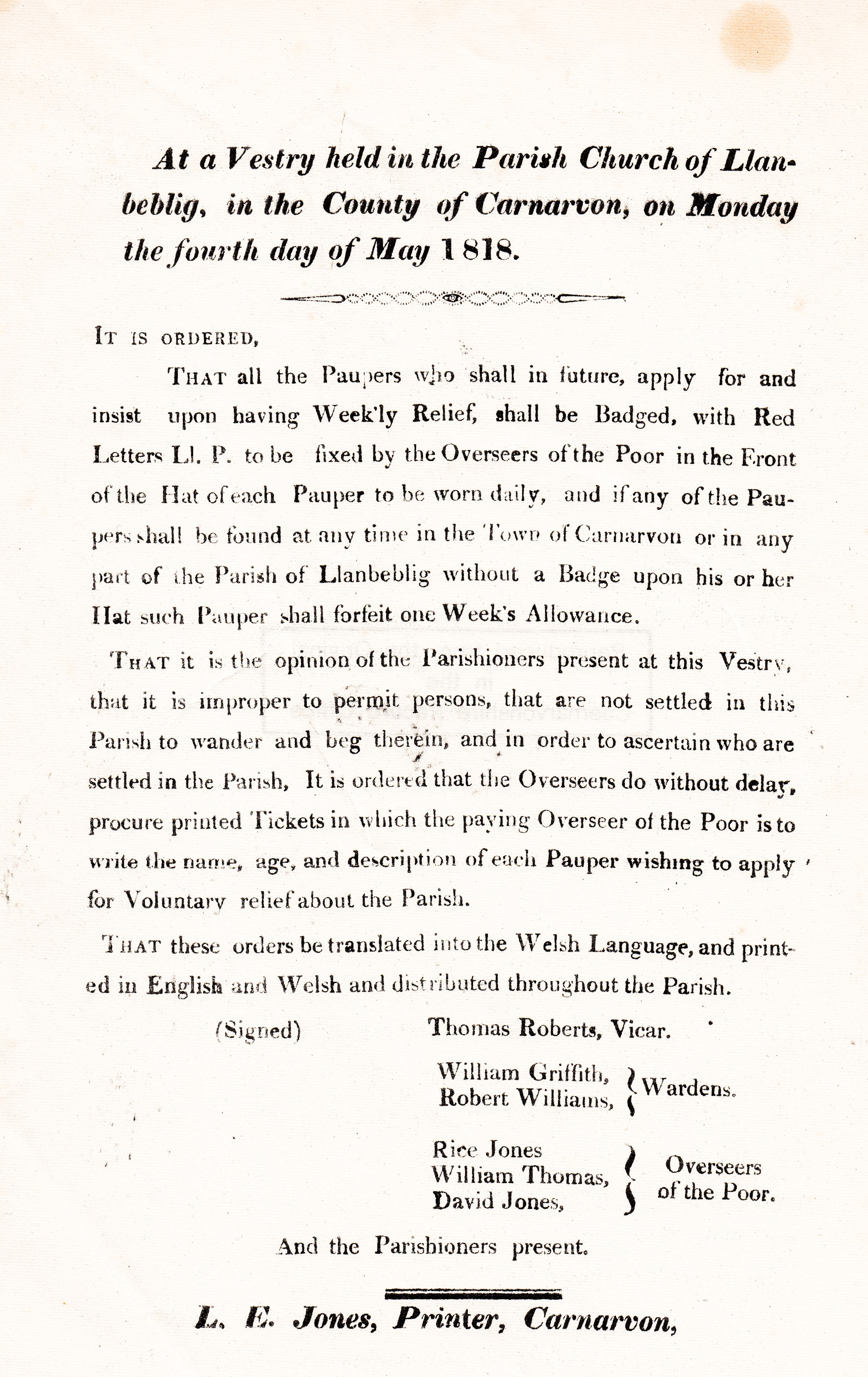
My favourite item (shown in the picture) is a printed notice from the Llanbeblig Parish Vestry in Caernarfonshire in 1818, one of the most recent archival documents offered in the file, which I had on the wall in one of my teaching offices, as an example of real stigma. Llanbeblig is effectively a suburb of Caernarfon.
For people who are not familiar with Welsh place names, ‘f’ in Welsh is often pronounced ‘v’, so when in the twentieth century, attempts were made to shift from the English pronunciation towards the Welsh the letter v was changed to f in many documents. So the file pre-dates these moves, and indeed the demise of Caernarfonshire in favour of the newly formed county of Gwynedd, (‘dd’ in Welsh is pronounced ‘th’). That took place in 1974, so when I bought it in the later 70s, it was a bit of a hangover of the past even then.
But it’s interesting, and I think good, that fairly hard-to-interpret archival documents are available for teaching purposes across the UK. I wonder what use the Gwynedd teachers made of them, and what understanding the children of the 1970s got from them.
You may remember from previous posts in Social work history bites that the ‘Parish Vestry’ was the local meeting, of worthies and any residents who were interested, to decide how to administer the Poor Law in the period before the 1830s centralisation of the system.
To save your eyesight, the first paragraph says:
IT IS ORDERED
THAT all the Paupers who shall in future, apply for and insist upon having Weekly Relief, shall be Badged, with Red Letters Ll. P to be fixed by the Overseers of the Poor in the Front of the Hat of each Pauper to be worn daily, and if any of the Paupers shall be found at any time in the town of Carnarvon or in any part of the Parish of Llanbeblig without a Badge upon his or her Hat such Pauper shall forfeit one Week’s Allowance…(Document 15)
To comment, one of the things about being poor is the inability of the authorities to enforce their wishes on people in poverty, unless they can beat or imprison them. Since the poor had nothing, then, unless corporal punishment is allowed, you could not punish them except through shame. You perhaps remember Nathaniel Hawthorne’s classic American novel about Hester Prynne who had an illegitimate child and had to wear The scarlet letter ‘A’ to signify to everyone her adultery; it’s the same technique. Used during the Holocaust to mark Jewish people in Germany by requiring them to wear a star.
And you can’t fine the poor, because they have nothing, but you can take away their allowance, which is exactly what sanctioning in the present British social security system does. We don’t get any better.
Document 15 rounds off its instructions for badging paupers with the following announcement:
That it is the opinion of the Parishioners present in the Vestry, that it is improper to permit persons, that are not settled in this Parish to wander and beg therein, and in order to ascertain who are settled in the Parish, It is ordered that the Overseers do without delay, procure printed Tickets in which the paying Overseer of the Poor is to write the name, age and description of each Pauper wishing to apply for Voluntary relief about the Parish.
Settlement – defining local Poor Law responsibility
This requirement introduces us to the problem of settlement. Paupers were only allowed to do things to assuage their poverty in the area they lived in (generally a parish in these past times). The administrative term for where a pauper lived was ‘settlement’, where they may be said to be live a settled life. Many of the documents over the centuries are concerned with working out who should pay for a pauper, and efforts were made to send them there so that someone else somewhere else should take on the cost.
Unfortunately, by the end of the 18th century, the agricultural revolution which was mechanising farming and the Napoleonic wars that were raising the death rate in the army, were causing people to lose their rural settled life. It is probably not coincidental that this document is dated 1818, since with the end of the Napoleonic wars in 1815, there were lots more unemployed former soldiers wandering around.
This passing of the buck is also not entirely gone from our present world either. Even in the 21st century noughties, in the hospice where I worked, I spent a good deal of time sorting out where people lived for the purposes of allowances for community care services. The English government guidance on paying allowances for nursing in nursing or residential care had to be amended to make it clear that health authorities were not to shuffle off their responsibilities onto some other authority because of where the patient was said to have lived. But they still tried when they could.
The misery of poverty
The documents in this collection demonstrate, casually in passing, much misery. Here’s a passing comment about Jane Williams, aged 34 years, in the Workhouse records for the Christmas Quarter 1866:
Roving [I read it thus, not as ‘raving’] lunatic found in a field bare naked except an old bedgown. She throwed off her petticoat. Had a Child with her whom she tighed [tied] an handkerchief round his neck, said she would hang him. Wm Hughes the Policeman and another man brought her here (Document 18).
This connects with what we have ben reading about the interconnections between the British asylum systems for lunatics and workhouses, the social security system of the time. And the role of the police, trying to keep order in a relatively rural area. The police in Britain’s cities now complain about having to deal with mentally ill people without the help of health services. But they always did, and they fall back on the institutions that are there.
Another entry in this same handwritten document refers to another inmate, whose name I can’t read:
…by sleeping in the lime kiln at [I can’t read this either] Burned very badly. Formerly…The husband deserted the wife and Children
People sleeping rough are always at risk because of the surroundings where they are forced to find shelter. It’s not clear whether the desertion by her husband is highlighted because it is seen as a misfortune that adds to her misery. I suspect it may simply be that by his absence he avoids the authorities seeking some payment for his wife and children and feeling the moral opprobrium for his act of abandonment.
Women’s dependence on family and male relatives
Morality and family connection are certainly issues for the authorities at this time. Another document reports on the investigation of a ‘vagabond’s’ right to poor relief:
The examination of Mary Humphries singlewoman a vagabond taken on oath before me …[unreadable] Thomas Esquire one of His Majesty’s [for American readers, this refers to the monarch of the time] Justices of the Peace in and for the said County of Carnarvon the eighteenth day of April 1800 Who on her oath saith [says] that she had been informed and believes that she was born in Wedlock [so legally not a ‘bastard’ in the terminology of the time] but does not recollect that she was ever told where she was from nor does she recollect even to have heard where either her Father or Mother was or were born and further saith that she never…did any[…thing] to her knowledge to gain a Settlement. Saith she has frequently been informed and believes that the Place of her father’s legal settlement is the parish of Myfod [now Meifod] in the County of Montgomeryshire and that her mother has frequently received Relief from the Overseers of the Poor of the said Parish of Myfod during the lifetime of this person’s father in his Right (Document 14).
Thus are women dependent on their family, and particularly paternal, connection.
A similar document from further ago, 2nd June 1788, describes a similar examination of Ellen Williams, vagabond (‘rogue’ is crossed out, so she was not an offender), by a Justice in Carnarvon:
…who saith that she was married near eleven years ago to one Owen Jones of the Parish of Llantysilio [probably – it’s fairly nearby but in a different county]…shoemaker. That the said Owen Jones died in his Majesty’s Service [that is, the army or navy] some years ago, and left her and two children totally unprovided for; that her said Husband often told her that he was born in the said Parish of Llantysilio, and the son of one Charles Jones…and that she never did…receive a settlement in her own right since the death of her said Husband.
The outcome of this examination is the latter part of the document, which sends them on their way, in the company of a police officer, to the county border:
To the Constable of the parish of Llandeiniolen [town near Caernarfon]…and to all other Constables whom it may concern to receive and convey, and to the Churchwardens and Overseers of the Poor of the Parish of Llantysilio…to receive and obey:
Whereas Ellen Williams, widow, and her two children, Anne, aged ten years and Margaret aged 9 years, apprehended in the parish of Llandeiniolen, … as Rogues and Vagabonds wandering and begging, and upon Examination of the said Ellen Williams…it appeareth that their legal Settlement is in the Parish of Llantysilio…
These [the document] are therefore to require you the said Constable to convey the said Vagrants to the Parish of […unreadable] in the County of Carnarvon that being the first Parish through which they ought to pass in the direct way to their said Settlement, and to deliver them to the Constable of the said Parish taking his Receipt. And the said Vagrants are to be conveyed on in like manner to the place of the legal Settlement aforesaid, there to be delivered to some of the Church-wardens and Overseers of the Poor, and to be provided for according to Law. And you the said Church-wardens and Overseers are hereby required to receive the said Vagrants and to provide for them as aforesaid (Document 11).
An earlier document still, of 1618, provides for young people to be set to work, mostly as apprentices or, in the case of girls until they are married. But there are complexities; Willian has to suffer a nine-year apprenticeship with only bed and board, and Gwen his sister, if she comes to notice again, will have to go into service, for example as a maid, or get married:
William Gruff his sonne ordered to be put apprentice to Owen ap William of Carrog for nine years onelie [only] for meate [food] and clothinge …but and if he be found wandringe and begging within the said parishe he is to be punished and brought by the bedle of the beggars [an earlier version of the ‘overseers of the poor’ in the 19th century documents] to the said Owen there to continue as aforesaid.
Gwen vch Gruff daughter to the foresaid Gruff ap Thomas whoe is now gone out of the parishe and liveth at Berthios…in service with one Robert ap William, ordered if she returne, to be putt in service to Thomas William Benllioyd eyther for seaven years or els till she be married.
On the other hand, John can support himself, but his wife and children can beg, since obviously it was accepted his wages were not enough to maintain them. And so can Harry, until he is strong enough to work:
John ap Robert ap Moris a poore man, with his weif and three children he liveth himself as a hired servant his weif and three children allowed to begge in the parishe…
Harrie ap Robert a little boye allowed to bee in the parishe for a while till he be stronger (Document 2).
Across the centuries efforts are made to manage people in poverty, often harshly, and some of the attitudes persist to the modern day. For example, recognition that wages are not enough to support a family is only an earlier version of the much-hated benefit cap of today, which limits the number of children you can claim benefits for.
Caernarvonshire Record Office (n. d.). Y Tlodion/The Poor (Local History Teaching File No. 1). Caernarfon: Caernarvonshire Record Office.